
The big word: Strategy
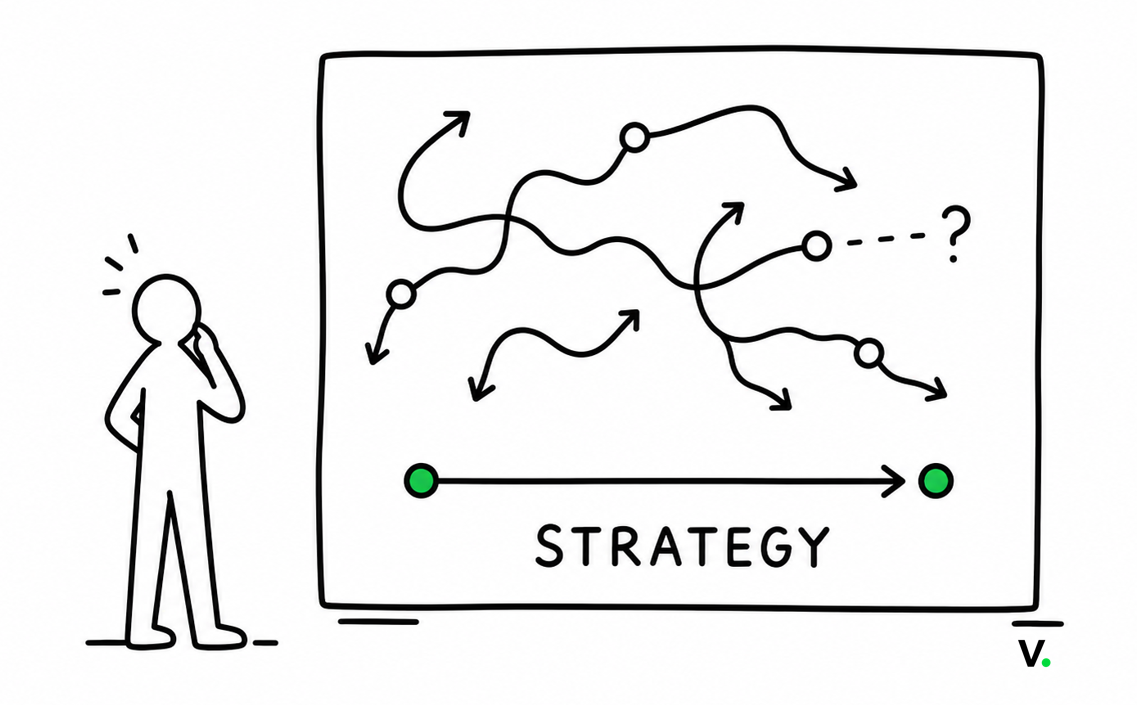
You’re just starting with an idea, maybe you already have the product and are thinking about the next steps. Maybe you just started a company, hired a couple of people and are thinking about how to capture the market. Or maybe you consider yourself already a startup with some customer logos that you can be proud of.
At this stage you keep hearing that there is this thing you should be doing, a word that you even hear from your investors (if you already have them congratulations and I hope you’re ok…), that word is Strategy.
Now you may be thinking “Do I even need that when all I have is an idea and a prototype (maybe grandma’s secret recipe for tomato sauce)”, Or “At this stage I don’t need to be doing anything big, I just need to put my head down and try to sell”, or worse you could be thinking “Hah strategy you say? I already have 10 strategic goals ready to implement in my presentation that I will show to everyone at our town hall meeting”.
If you are any of the above, I think you may have a misunderstanding of the concept. And don’t get me wrong, in the sea of articles and posts titled “10 marketing/business/whatever strategies to have this year” it is understandable to lose track of what strategy at the core really is.
First, What strategy isn’t
Strategy isn’t a bunch of pretty words that sound cool. It isn’t the smartest-sounding thing, a collection of buzzwords, or an ambitious-looking plan on the surface with nothing happening underneath.
Strategy also is not just an ambitious goal in itself, and it definitely isn’t a list of 20 “strategic” goals. And don’t listen to anyone telling you there are 20 strategies to do something. More often than not, what you're looking at is a list of tactics, or actions at best, but not a strategy.
If you fail to understand where you are, what problems you have, or if you decide to turn a blind eye to what problems you actually have by just trying to keep pushing for vague ambitions (We are going to be the best, cause that’s our goal duh!), then you will lose the trust of even your team.
And no it isn’t we are gonna make it cause we have AI now and we will utilize it strategically (if I had a dollar....)
Strategy, singular please.
What is strategy then? Merriam-Webster defines strategy as “a careful plan or method for achieving a particular goal usually over a long period of time.” Notice that it’s a single plan or method, and kindly also notice that I wrote long period of time and particular goal in bold.
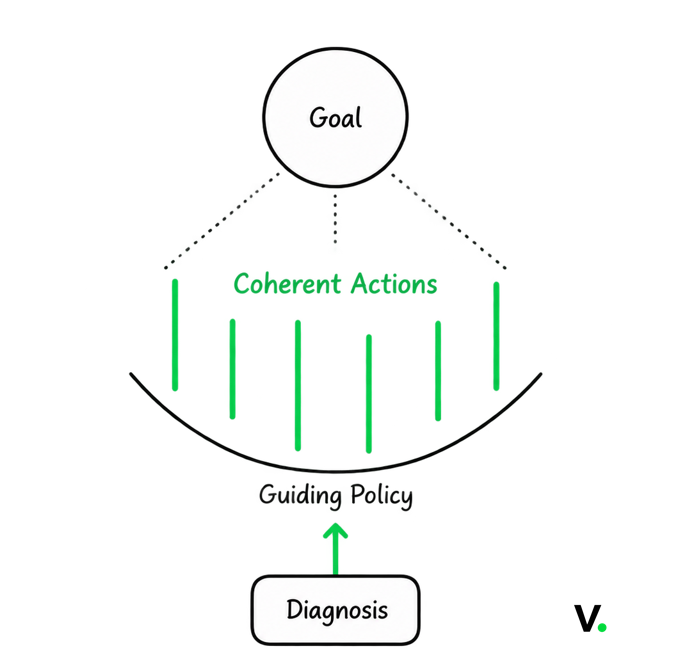
I personally subscribe to the concept presented in Richard Rumelt’s Good Strategy/Bad Strategy. **Richard Rumelt represents strategy as a coherent response to an important challenge. He argues that any good strategy is made of a kernel that is made of three parts: Diagnosis, Guiding Policy, and Coherent Actions.
These are a lot of big words that make it seem like a strategy is something that needs a whole team of strategists, equipped with the best diagnostic tools, writing policies and trying to decide on what actions to take next.
But it isn’t that complicated. It can be done on a single piece of paper (preferably one paper not a PPT of 20 to 30 pages), and it can be worked out with the simple understanding of where we are, where we want to be and what we should do to get there.
The Steps to build your strategy
Before the kernel: Know where you want to go
Try to understand where you want to be/go, basically your goal. This is your compass before getting into anything else. This has to be long-term, and it has to be ambitious, something that looks like the future you want to have.
It has to be something like I want to establish a market for my product, we want to have the best sales in our category, we want to have a global business by making our sales 80% from global markets, or we want to be the most well-known brand in so & so market (grandmas’ secret recipes tomato sauce market comes to mind). Or it can be a challenge you need to overcome, like we are losing market to cheaper low quality tomato sauces.
*It’s important to avoid two things.
Confusing what I just wrote with making “A List of top 10 things we need to achieve”, or “Here are 30 bullet points of what our vision is.” Those are the things that sound strategic but won’t help.
If your goal is to increase sales by 10% next month compared with last month, that’s not a goal that can help you set a strategy. It’s merely a performance enhancement. And if your goal is to be the best in the tomato sauce category on Amazon next week, that is also not something that can help you set a strategy. Nothing wrong with either, but they won’t help you think long term, and won’t help you set a strategy that would prove strong against market tides. Those are more KPIs or objectives than actual ambitious goals.
The strategy kernel
Diagnosis:
In the first process, we need to identify the critical challenge preventing us from reaching where we want to be. This requires understanding our current position, strengths and weaknesses, customers, competitors, market conditions, opportunities, and other relevant factors. Here we ask: given our ambition, what is the critical challenge, constraint, or opportunity that matters most?
Remember your doctor’s visit (sorry), he/she takes a look at you, checks your symptoms, orders tests, draws some blood, all to figure out how to help you overcome whatever it is you’re feeling.
Guiding Policy:
Now that we have diagnosed our situation and understood both the challenges we are facing and how far we are from where we need to be, we decide on the overall approach we will take to achieve that ambition or overcome our challenge.
Say after the diagnosis you discovered that you have your secret recipe tomato sauce packaged, branded, and ready to sell. But you only have a few boxes worth of it, and you don’t have the headcount or the financial resources to make large quantities. If your ambition was to have recurring revenue and automated sales channels, do you start by directly going to the largest nearby supermarket and asking them to give you shelf space? Or is the better approach to get more revenue first by selling at farmers’ markets?
A good guiding policy should do three things: focus effort on what matters most, rule out some alternatives, and give different actions a common direction.
Coherent Actions:
We have made our diagnosis and understood where we are, and based on that we decided on the overall approach (guiding policy) we need to follow, the one that makes the most sense based on our diagnosis. Now we have to decide on the actions/steps we need to take within this approach to get where we want to get. These actions have to be coherent, and they will be if we base them on the guiding policy.
Back to your tomato sauce, now that you know that you have no resource or power to fight for shelf space against the big guys (albeit cheaper lower quality guys), you decided that the best guiding policy is to focus on smaller markets and niche shoppers looking for quality over convenience and cheap prices. You start setting up your actions:
Sell through specialty grocery stores, farmers’ markets etc. Keep the prices premium. Focus your marketing on food enthusiasts and quality-conscious shoppers. Produce fewer varieties and focus on quality of a small number of products. Invest revenue in growing your manufacturing…you get the idea.
The important part is that these actions are not just good individual ideas, they are coherent cause they follow the same guiding policy, and they will ultimately all interconnect and lead you toward where you want to go.
Strategy makes an unclear, uncertain future reachable
And there you have it, hopefully now you see that there are clear benefits to building a strategy. It helps you take your business to where you really want it to be, by facing challenges and uncertainties head-on.
Avoid the fluff, and the pretty strategic talk. Strategy is a process, not a statement.
And remember: know where you want to go, diagnose your situation, find the right guiding policy, then build coherent actions around it.
