
So You Have an Idea
We have all been there. You have an idea for something great. Starting Vantage started with an idea as well. The idea was that there must be people out there with ideas that can truly make a difference in the world, but they don’t know how to turn them into reality.
People often say that starting is the hardest part, and this applies to starting a business as well. But I imagine that starting a business/startup is hard not because of how difficult it is to get up and do something (like joining the gym, remember that first day?), but because you don’t know whether the idea that sounds good in your mind will actually sound good enough to other people for them to buy it. You can put the idea on paper, scribble, and draw tables. And even if it looks good on paper, you still won’t be sure. You can tell your loved ones and share your vision with friends, but through their excitement (or raised eyebrows), you could (will) become more hesitant.
Many things on the line.
It is understandable and, quite honestly, natural to be hesitant (terrified even). We are not talking about starting a new hobby or taking up baking classes. When it comes to starting a business, we are talking about money and livelihood. We are talking about leaving your stable job, pursuing something unknown, and venturing into a future that could possibly be (and often is) an uncomfortable one.
That applies as well if you already have an established business and you’re thinking about whether to add a product/feature to your portfolio, or maybe you’re considering pivoting to another type of product. It’s not an easy feat, given how much effort and how many new skills it requires, and if it doesn’t work, it could cause you to lose the confidence of your team.
So how do you know? How can you tell if your idea has actual value that people are willing to pay for, if the market would want it, or if those excited friends who said, “Of course, a plug-in espresso machine for my electric car will make my morning commute so fun!” will actually buy it?
First, don’t ask about your idea.
You know the saying: don’t ask a question you don’t want the answer to. Because the answer might cause you pain, or worse, you’ll learn that you’re not your parents’ favorite. But when it comes to an idea or a business, you shouldn’t ask because you will most likely hear something you like.
When you look for feedback on your idea, you will usually turn to those who are closest to you: friends, family, and coworkers. Those tend to be the types of test subjects who are accessible to you. And the thing about people (especially the ones close to us) is that they hate confrontation, want to be nice, and avoid uncomfortable conversations at any cost.
Even if you have access to people who could be considered potential customers, if you just ask, “What do you think about this electric car espresso machine I made, and would you buy it?” chances are they will say, “I would!”
Then, what to do instead?
*A note on asking about your idea. There are many proven methods for conducting customer interviews and extracting information, but that’s not our focus here; we want to focus more on the steps you would take to confirm that you have something worth pursuing (or at least avoid going at it blindfolded).
There are a lot of schools of thought and traditions around testing a product, a business, or an idea before starting to build or going to market. How to conduct customer research, how to look at your potential competition, and how to measure your expected revenue, etc. But I find that a framework, a sort of mental guide that you can keep in mind as a founder, is easier to follow and helps ground your thoughts in reality.
For this, I find the framework in Marty Cagan’s Inspired the most applicable and easiest to follow, no matter what stage you are in, whether you have an idea for a business or a new product, or you’d like to make a pivot.
Cagan’s framework identifies four risks; an assessment of each is supposed to give you an understanding of whether what you’re building or trying to do is worth pursuing. The risks to assess are value, usability, feasibility, and business viability. In this article, we will focus on value assessment, as it is the part that helps you understand whether people will find value in your idea.
Note: The book Inspired focuses on technology products, and, more specifically, it targets product managers. However, I find that its framework is quite practical and applicable to all types of businesses.
Value - Are they actually going to buy your product?
The first and probably the most important part of Cagan’s framework in assessing the risks of a new product is to assess whether your target customers would actually buy the product/idea you’re selling (so we will take our time with it). This step is so important and equally difficult because of two things: as we said, people love to please, and people won’t tell you (or usually even know) how they actually feel about something.
Second, it is because it’s so easy to look for confirmation of your idea (look up confirmation bias) in everything you see. And avoiding this mental trap is a very important (if not the most important) thing to keep in mind during evaluation.
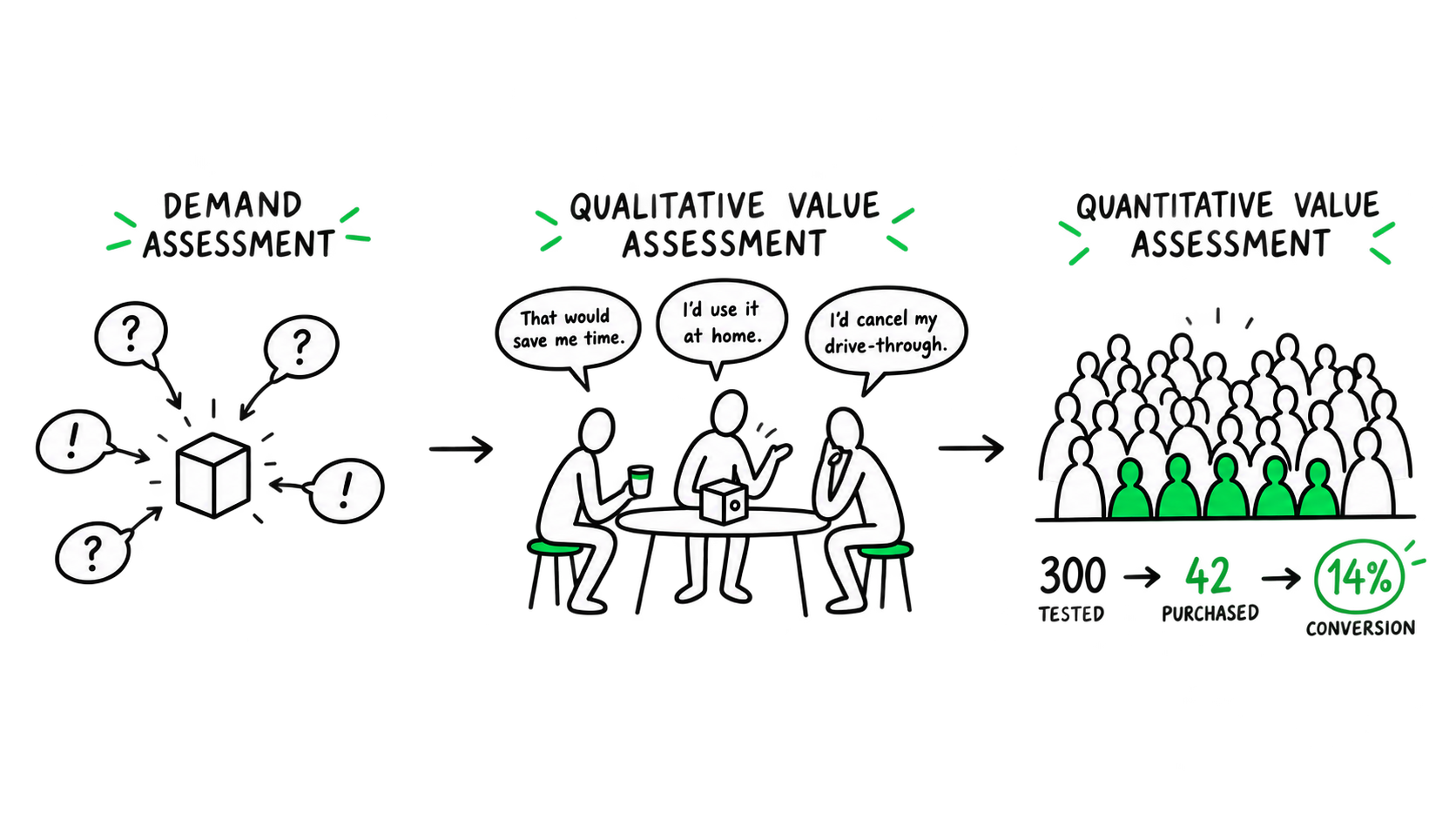
To assess value, Cagan guides us to three things that we should look for (not necessarily in order):
Demand:
The demand assessment is the filter that helps us know whether it is worth building anything before making any commitment. This is the part that asks, “Are there actually people interested in this?” Hanging an ad that says “Quick-to-install espresso machine for your electric car” with a QR code that leads to a landing page. And seeing how many people visit the landing page and maybe submit a “Request Info” form. That is before you even spend time or money on building the machine. If 200 out of 1,000 visitors send you an email asking to see the machine, you have a good indicator of people’s demand, and a simple measure of what to expect. That of course is a very straightforward example, and one ad won’t tell you everything you need (maybe not that many people saw it, or only the wrong people saw it). So don’t be discouraged if the results are meager, and try multiple channels to find your target audience rather than pouring all your hopes into one.
Qualitative value:
Let’s say that you have found enough demand and you have decided to go further and understand that demand better. So you take your prototype, go to the “Baristas of the future trade show” (not sure if it exists), and start showing people your product. Here, you get to test not just how excited people are about the product or how they react to it (Remember don’t ask!), but we look for signals that indicate that they actually see value in it, and that they believe it will benefit them. You may find that one person likes it because his commute takes 90 minutes; another might find it unnecessary because he loves Starbucks’ drive-through. A commitment can make this evidence stronger. If someone agrees to test it in their car, gives you access to observe their commute, or places a deposit, that reveals more than a compliment.
The information you gain from this assessment is who finds this valuable and under what circumstances, what prevents someone from choosing it, and what alternatives you may be replacing with it. You can basically build a realistic use case (or, hopefully, multiple use cases) for your product.
Quantitative value:
We understand the strength of initial demand, and we kind of know what value people perceive in our product, but we need to test whether this will also hold for a larger group (with real money). This time, let’s target a specific channel with an initial batch of, say, 300 machines. This could be at the “Tesla lovers” roadshow. However, now you are not looking just at how visitors interact with the product; you are measuring how many people will hand you $200 and take the machine with them. Of course, you still need to count how many relevant visitors encountered the offer, because selling 30 machines to 100 people is very different from selling 30 to 3,000. Then, out of those buyers, how many recommend it to their friends? How many return it? And maybe how many tell you that it actually saved them from making “this many” drive-through visits?
For stronger evidence, you could first record how often participants currently buy coffee during their commute and then compare that behavior with what happens after receiving the machine. That would reveal whether the product genuinely changed their routine rather than merely becoming an additional gadget.
Conclusion: We are good to go, let’s register EV Espresso Incorporated*….right?
After all three assessments, you should have an idea of how strong the initial demand signals for your product are, who finds the product valuable and why, under what circumstances they would choose it, what currently prevents them from choosing it, and whether that value continues after purchase through retention, returns, referrals, etc. You should also have a grounded (but very useful) indication of likely purchase behavior among similar customers.
Now you can kick back, close your eyes, take a deep breath, and dream of the coffee empire you will build. Step aside Starbucks, you had your moment. But not so fast.
We have evaluated what value people perceive in your product and whether that value could get them to actually spend money on it. We have yet to test whether people can actually get that value out of your product (Usability), whether you can effectively build and deliver enough of it under your skill and resource constraints (Feasibility), and, even if it’s valuable, usable, and technically possible, whether it is still viable as a business (e.g., whether we can sell it, market it, make a profit from it, etc.) (Business viability). We will need to look at those assessments separately at a later time.
